
Share this post:
Estimated reading time: 10 minutes
🎧 Available in audio
You can listen to this article, The Breathless Cell: Otto Warburg’s War on Cancer Inside Nazi Germany, narrated in full. Whether you’re walking, driving, or just prefer to hear it aloud, click play below.
Prologue – Why Write About Otto Warburg?
Otto Warburg was one of the most brilliant, and most troubling, scientists of the twentieth century.
His name endures through the Warburg effect: the observation that cancer cells favor a primitive, oxygen-avoiding form of metabolism. I’ve been drawn to this idea for years, not only because it continues to shape cancer research, but because it pushes back against the comfort of genetic certainty. Warburg insisted that energy mattered. That how a cell lives might matter as much as what it mutates.
Warburg was of Jewish descent—a Mischling under Nazi racial laws, yet he remained in Berlin, running a prestigious research institute, while many of his colleagues were dismissed, exiled, or murdered. No document explains how he stayed. That he did at all is unsettling.
Some later accounts have linked Warburg’s survival to Adolf Hitler’s personal fear of cancer, the disease that killed his mother. Whether true or not, the idea captures something real about the regime: Warburg was useful, and usefulness could outweigh ancestry.
Warburg was famously arrogant. Not charmingly so. Not defensively so. He dismissed colleagues, provoked enemies, and seemed genuinely uninterested in whether he left damage behind.
At one gathering of Nobel laureates, he reportedly said that only his own cancer research mattered, and that everything else was “garbage.” He must have been exhausting. And yet, even those he humiliated would later concede the same thing: he saw what others missed.
And then there is what he did not say.
Warburg never married. He spent most of his adult life with Jacob Heiss, his lab manager and companion. Many have assumed he was gay, though he never spoke of it. His private life remained closed—not hidden, exactly, but sealed.
That restraint extended far beyond intimacy. Warburg said almost nothing about politics. Nothing about the regime under which he worked. Nothing about the colleagues who disappeared. He left no protest, no explanation, no reckoning. In his world, silence was not a gap. It was a defense.
And then there is the contradiction that does not resolve.
Warburg lived, worked, published, and in many ways flourished under Nazi Germany. After the war, he told his sister that he feared he had made a “Devil’s pact,” kept alive for foreign propaganda. Survival comes at a cost. He never said what that cost was. He didn’t need to.
That ambiguity still weighs on me.
For all these reasons, scientific, historical, psychological, and deeply personal, Warburg’s story feels worth telling. Not because it offers answers, but because it refuses them. It reminds us that science is practiced by people, and people are shaped by the world they endure, not just the ideas they defend.
To understand Otto Warburg, you have to imagine working before code, before sequences—when the cell gave nothing away. Results did not appear on a screen. Answers came slowly, earned through repetition, precision, and a kind of attention that did not let go. Warburg lived through war and upheaval, but he returned again and again to the same conviction: that cancer begins not in genes, but in how a cell handles energy, how it breathes, or fails to.
His laboratory outside Berlin became both refuge and stage.
That is where the story begins.
The Lab Without Shadows
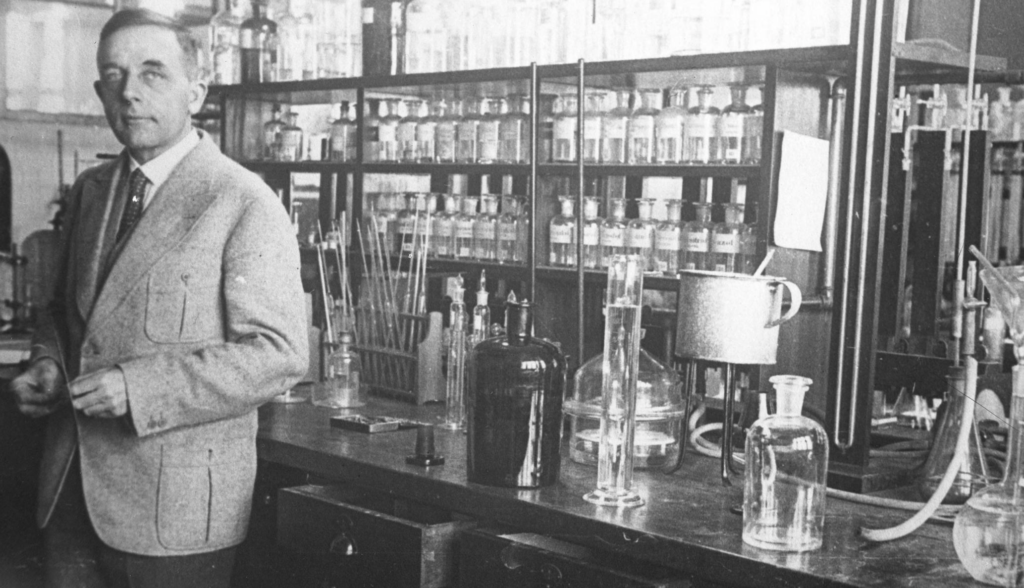
Berlin-Dahlem, 1942. Just past the iron gate of the Kaiser Wilhelm Institute for Cell Physiology, a man in riding breeches and a white lab coat leans over a glass chamber. He adjusts the fine tubing of a manometer, measuring, once again, the oxygen consumption of a cancer cell.
The instruments gleam. The light is white and cold. The assistants don’t speak.
This is Otto Warburg, Nobel laureate, biochemical virtuoso, racial outsider.
His father had been born Jewish before converting to Protestantism. Otto himself had been baptized. But under Nazi law, none of that mattered. He was a Mischling. A half-Jew. Someone who, by all rights, should have been removed from his post long ago.
But Warburg remained.
Rumors circulated that Hitler had ordered him protected. Others believed Göring had intervened. Warburg himself never commented. “Retain for ten years for foreign propaganda,” he would later imagine the note by his name might have read.
What saved him was his science, or so it seemed. No definitive record explains why he was spared. Only the results of his research and the silence he maintained remain.
He had built an institute, created a theory, and held the admiration of much of Europe’s prewar intellectual elite. And now, under the veil of war and repression, he pursued one quiet obsession: why do cancer cells refuse to breathe?
He thought the answer lay not in the genes, but in the mitochondria, the cell’s engines. Cancer, he believed, was not a mutation of information, but a failure of respiration.
Not everyone agreed. But no one else had lived through the Reich like this. Surrounded by silence, Warburg kept measuring.
The Young Prodigy
Otto Heinrich Warburg was born in 1883 into a household that prized intellect. His father, Emil Warburg, was a distinguished physicist. Einstein visited the house. Ideas lived in the furniture.
Otto studied chemistry under Fischer in Berlin, then medicine in Heidelberg. He earned two doctorates. His curiosity ran toward metabolism: oxygen, sugar, energy, and respiration. What made life run.
In 1914, he joined the cavalry. Volunteered. Served at the front. Won the Iron Cross.
Even at the front, with shells falling around him, his mind kept returning to cells.
Back in Berlin after the war, he founded his lab at the Kaiser Wilhelm Institute. It would become a kingdom—precise, orderly, sealed.
His methods were fanatical. Instruments were custom-built. Assistants followed his strict routine. He demanded cleanliness, silence, and repetition.
In 1931, he won the Nobel Prize for identifying key enzymes involved in cellular respiration, how cells transfer oxygen and turn it into usable energy. But already, his mind had moved to a deeper theory.
When respiration fails, he believed, cells revert to fermentation, a fallback mode of survival in which sugar is burned without oxygen. That, he claimed, was the root of cancer.
The world was not yet ready to hear him.
Warburg vs. the World
Warburg’s idea, that cancer was fundamentally a metabolic disease, landed in a world increasingly captivated by genes.
By the 1950s, DNA had taken center stage. Molecular biology was rewriting everything. Cancer, the new generation believed, was caused by mutations—mistakes in the code, not failures in respiration. The somatic mutation theory rose to dominance.
Warburg wouldn’t hear it.
He continued to argue, sometimes calmly, sometimes furiously, that respiration came first. The cell’s ability to use oxygen collapsed. Fermentation took over. That shift, he believed, made cells both immortal and malignant.
“Cancer, above all other diseases,” he wrote, “has countless secondary causes. But, even for cancer, there is only one prime cause. The replacement of the respiration of oxygen in normal body cells by a fermentation of sugar.”
He repeated that sentence in paper after paper. It was a mantra. A line of battle. He believed he had discovered the cause of cancer, and the rest of the world had lost its way.
The world, meanwhile, believed Warburg had become irrelevant. His tone grew harsher. His circle shrank. Former colleagues distanced themselves. Even allies found his rigidity uncomfortable.
At a gathering of Nobel laureates, Warburg reportedly told the audience that all cancer research not focused on fermentation was “garbage.” One attendee later said, “If arrogance was measured from one to ten, Otto rated twenty.”
He worked each day as if trying to out-measure the world’s betrayal.
Still, the research continued.
Some of his claims were extreme. But many of his measurements were accurate.
He was mapping a phenomenon before there were words to hold it.
Silence as Survival
All the while, he said almost nothing about the war.
Warburg never published a word about the regime that had killed his colleagues. He never gave a statement, signed a protest, or issued a letter after the war ended. He received visitors. Spoke at conferences. But he rarely addressed the years that had changed everything.
That silence has puzzled biographers.
Was it fear? Opportunism? Moral compartmentalization? Or the same narcissism that fueled his scientific arrogance? We don’t know. Perhaps he didn’t, either.
Some historians see it as a strategic withdrawal. Others as moral failure.
I see it as a deeply human void. A part of him sealed shut, where questions were not answered, only contained.
It’s tempting to think of science as immune to context, as if Warburg’s brilliance somehow insulated him from the choices others had to make. But there’s no such insulation. The lab is part of the world.
And in that world, Warburg’s silence speaks volumes.
Resurrection
For decades, Warburg’s theory remained on the fringe. The field moved on. Genomics triumphed. Cancer was mapped in base pairs. It was sequenced, subtyped, targeted.
And yet…
In recent years, something unexpected happened.
The metabolism returned.
Scientists began to realize that cancer cells do indeed show altered metabolism. PET scans, used every day in oncology, detect tumors based on their glucose uptake, a direct legacy of the Warburg effect.
Modern researchers now accept that metabolic shifts are part of cancer’s progression. Not the only cause, but a critical enabler. Mutations drive it. Metabolism helps it survive.
“Genetics and metabolism are not rivals,” one researcher put it. “They’re partners in crime.”
Warburg was wrong to dismiss genes. But he was right to focus on energy.
What was once dismissed as obsession has become infrastructure. Cancer metabolism is no longer fringe science; it now underpins entire research programs, therapeutic strategies, and ways of thinking about the disease.
His theory, once ridiculed, now shapes entire fields.
And the questions he asked, about oxygen, survival, cellular identity, remain vital.
Some researchers have even tested dietary approaches to cancer. Calorie restriction, ketogenic diets—ways to starve the fermentation engine. The results in animals are promising. In humans, they remain uncertain. But the door is open.
One can imagine Warburg watching the resurrection of his theory with a mix of triumph and disgust. He might ask: what took you so long?
Epilogue – The Cell That Would Not Die
Warburg died in 1970 at the age of 86.
He had survived the Nazis, the fall of his reputation, and the rise of an entirely new biology. He never married. He rarely traveled. He lived with Jacob Heiss until Heiss died, then continued alone.
His institute in Berlin is still there. So are his papers. His instruments. His name.
The Warburg Effect remains one of the most cited phenomena in cancer biology.
But his life resists tidy conclusions.
He was a man who refused to breathe the way others did. Who insisted the truth lay not in the nucleus, but in the mitochondria. Who lived inside one of the darkest regimes in modern history and emerged intact, but not without questions.
And maybe that’s the most human part of the story.
Because we want our heroes to speak. We want them to choose. We want clarity.
But Warburg left only the data.
No confession.
No condemnation.
Only silence.
And sometimes, a man survives a regime by holding his breath.
Further Reading
Readers who wish to go deeper may want to begin with Otto Warburg himself, his own writings, especially The Metabolism of Tumours, and his later reflections in On the Origin of Cancer Cells. For a measured and authoritative account of the man behind the work, Hans Krebs’ biography remains the most balanced portrait, written with both proximity and restraint.
The historical setting is best understood through Ulrike Deichmann’s Biologists Under Hitler and Robert Proctor’s Racial Hygiene, which show how scientific value, political power, and moral compromise intersected under the Third Reich. Together, they help explain how usefulness could outweigh ancestry.
For the modern scientific context, the work of Hanahan and Weinberg, alongside later analyses of cancer metabolism, shows how Warburg’s ideas, once marginalized, have quietly returned to shape contemporary oncology.
Sam Apple’s Ravenous: Otto Warburg, the Nazis, and the Search for the Cancer-Diet Connection is a carefully reported biography that situates Warburg’s science and survival within Nazi Germany, while tracing the long, uneasy afterlife of his ideas.
Þessi grein er glæsileg bæði að efni og formi; afar ánægjuleg að lesa og ígrunda; aðdáun mín á höfundinum, mikil fyrir, vex við lestur þessarar greinar.